
Our Impact
Five years of research reshaped how the field understands literacy development in grades 3-8.
We did more than study a problem. We clarified it—and offer a path forward for the future.
About Reading Reimagined
Reading Reimagined focused on one underexamined area of literacy development: advanced decoding skills in grades 3–8.
As academic texts grow more complex, the word-reading demands increase. The initiative investigated whether gaps in those skills were contributing to stalled comprehension growth— and what that revealed about instruction and assessment.
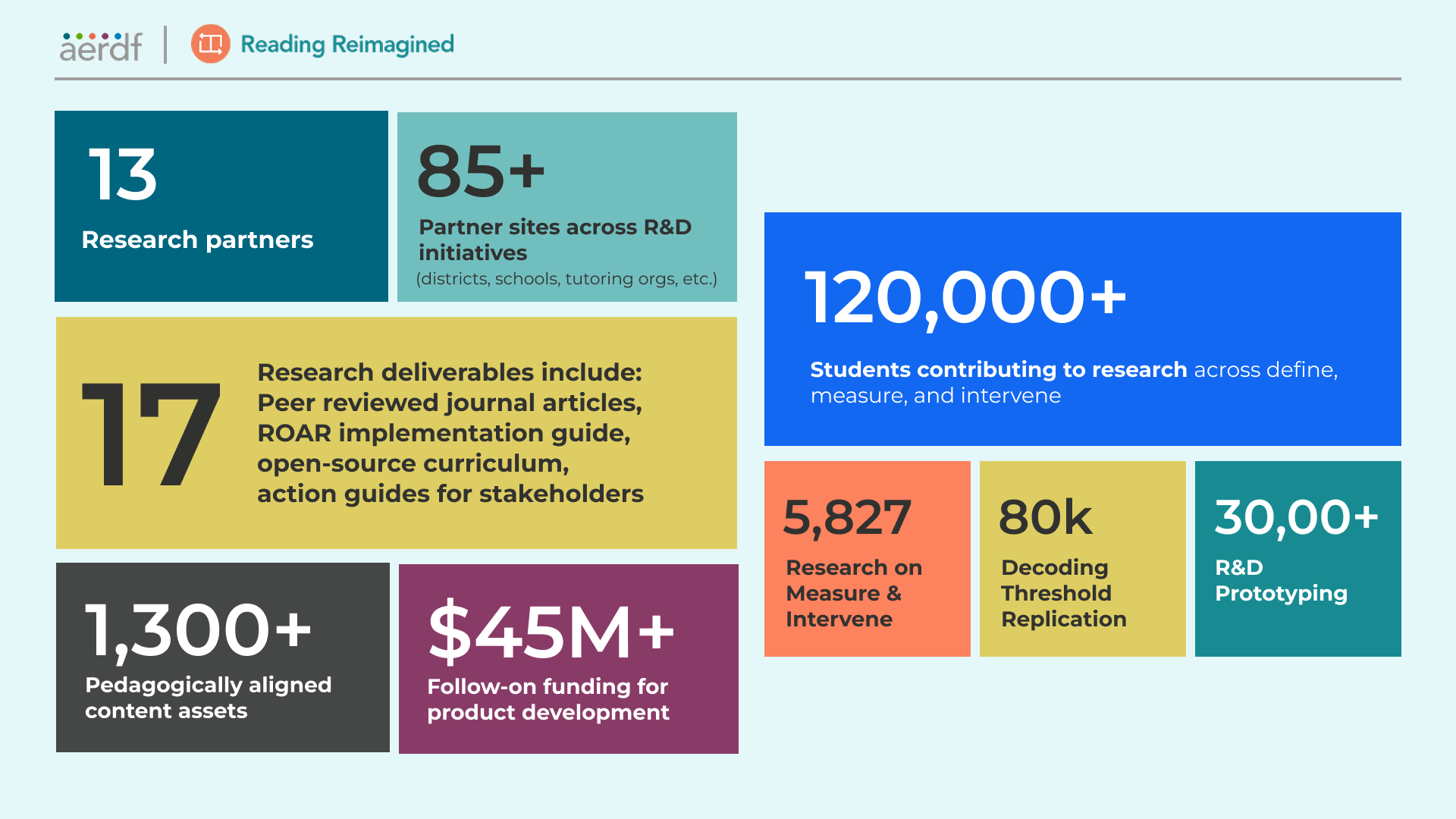
The initiative by the numbers

The Older Student Literacy Gap
National reading outcomes remain low. Just 31% of fourth graders and 30% of eighth graders score proficient or above on NAEP.
In recent years, many states have invested heavily in improving early literacy instruction. In states such as Mississippi and Louisiana, fourth-grade reading scores have risen as a result.
But by eighth grade, that growth largely flattens. Many students who appeared on track in early elementary school are not maintaining proficiency as text complexity increases.
This pattern suggests that improving early literacy alone is not sufficient to ensure sustained reading growth through upper elementary and middle school.
Early Decoding Skills Aren’t Enough for Complex Text
For example: Kids may be able to sound out short words they know:
c-a-t
but struggle to break longer, unfamiliar words down into smaller parts, and use word parts to infer meaning:
education
catalyst
cathartic
Decoding isn’t something you learn once. It gets more complex as words get harder.
Reading Reimagined partnered with ETS to understand the relationship between decoding and comprehension. The ETS study assessed students on words appropriate for their grade level, from grades 3-12. As the words get more complex, decoding gets more challenging. The skills that allowed the same students to read a second-grade level test are no longer sufficient in later grades, because of the rapidly increasing complexity of the language they encounter.
Bridging the gaps for older readers
The early skills that many students build in K–3—even when taught well—are not sufficient on their own.
To sustain reading growth, foundational skill development must continue advancing in complexity from kindergarten through eighth grade.
Recommendations
The research points to coordinated action across systems, with a critical first step: changing our collective mindset about how and when students learn to read.
It’s time to view learning to read as an active, developmental process that demands explicit whole-class instruction in foundational skills that advance in complexity from kindergarten through eighth grade.
What happens requires teamwork between state policymakers, district and school leaders, and classroom teachers.
View Our RecommendationsPolicymakers Lead the Way
Despite widespread early literacy reform, most states do not address advanced foundational literacy skills beyond third grade. We call on state leaders to revise grades 4–8 standards, require universal and developmentally appropriate literacy screening through grade 8, and ensure high-quality instructional materials reflect these expectations.
Learn MoreInstructional leaders can scale literacy with technology
We encourage district and school leaders to adopt developmentally appropriate literacy assessments that measure advanced decoding skills in the upper grades. Emerging tools such as Magpie connect assessment, instruction, and progress monitoring into a more coherent literacy experience for students.
Learn MoreTeachers carry learning forward
Teachers need practical strategies to support advanced foundational literacy skills. We recommend adopting simple instructional routines, making consistent use of existing curriculum units focused on multisyllabic decoding and morphology, and leveraging technology to provide targeted word-level practice.
Learn More